

PUBLIC MEETING: Organisational resilience of civil society under external pressure
16 October - 17:00 - 20:00
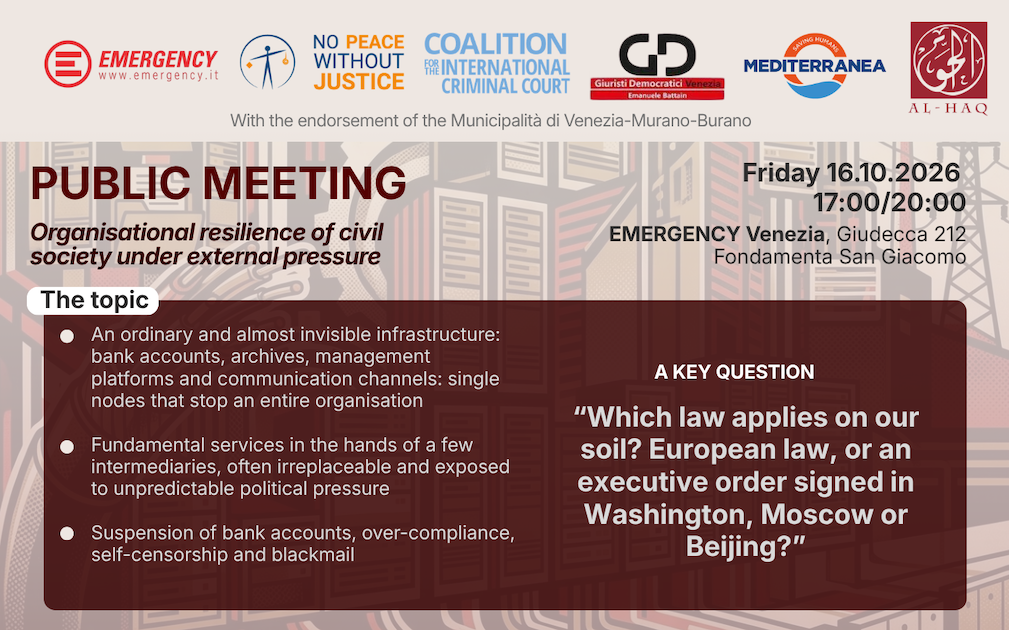
Bank accounts, archives, management platforms, communication channels, insurance and payments: intermediaries that are often irreplaceable and themselves exposed to unpredictable political pressure. How can operational continuity be ensured in a system built around a few chokepoints, and what policy response could secure European financial and digital sovereignty?
- When: Friday 16 October 2026 – 5 pm to 8 pm
- Where: EMERGENCY Venezia – Giudecca 212, Fondamenta San Giacomo
- Free entry, registration required: Register at tinyurl.com/NGOResilience
- Program
Programme
17.00 Welcome Rossella Miccio, President, EMERGENCY
Opening remarks Giovanni Pelizzato, President of the Municipalità di Venezia-Murano-Burano
Introduction Tara O’Grady, President, No Peace Without Justice
17.20 Panel discussion
Stefano Quintarelli, Computer scientist (online)
Zoe Paris, Advocacy Director, Coalition for the International Criminal Court
Fausto Gianelli, Lawyer for Autistici/Inventati
Roberta Borroni, Vice-President, EMERGENCY
Ahmed Abofoul, Legal Advisor, Al-Haq
Luca Casarini, Head of Mission, Mediterranea Saving Humans
Matt Cannock, Centre for International Justice, Amnesty International
Alvise Nicoletti, Founder and CEO, ELAN42
18.30 Open discussion Moderated by Niccolò Figà-Talamanca, Secretary-General, No Peace Without Justice
19.50 Conclusions Alison Smith, Convenor, Coalition for the International Criminal Court
20.00 Close
Background
An almost invisible infrastructure
Every organisation, small or large, rests on an ordinary and almost invisible infrastructure: the bank account
that receives its grants and pays its salaries, the archives and management platforms that hold its documents,
contracts and institutional memory, its email and messaging, its insurance, its payments. These services are in
the hands of a few intermediaries, often irreplaceable in the short term and themselves exposed to
unpredictable political pressure. The resulting architecture has grown around a few nodes without anyone
designing it that way: each dependency is a critical point with no alternative, and the dependencies add up.
When a node gives way, the organisation stops, even if it was never itself targeted.
From the International Criminal Court to an ordinary bank transfer
At the most visible extreme are the sanctions imposed, under the same executive order, on judges and
prosecutors of the International Criminal Court and on three Palestinian human rights organisations that
cooperate with it, Al-Haq, Al Mezan and the Palestinian Centre for Human Rights: measures contrary to Italian
and European law, which nonetheless take effect in Europe, because banks, payment networks and digital
services depend on nodes located elsewhere.
At the end of August the same tool was turned on a small Italian volunteer collective, which had offered free
email and websites to associations and activists since 2001: the United States government placed it on a
counter-terrorism list. A few days later its bank, an Italian ethical bank, suspended its account rather than put
at risk the cards and international payments of all its customers. In early September the collective shut down
all its services.
At the other extreme there is no list, only over-compliance: a compliance system that goes well beyond
anything the law requires. An organisation pays a staff member in a country automatically classified as “high
risk”: almost every time, even for recurring payments, the machine flags the transfer, the payment (and
sometimes the account itself) is suspended, and the bank’s compliance office has to phone to ask for the donor
contract, the invoice or the payslip, and then release it manually. If this happens three times a week, the bank
closes the account on a simple cost-benefit calculation, knowing full well that everything is in order. An
organisation afraid of losing its account starts choosing projects, partners and words with the bank in mind:
that is how self-censorship and blackmail take hold.
Organisational policies and policy responses
On 16 October we will discuss this on two levels. The first concerns organisations: which governance choices,
redundancies and contingency plans ensure operational continuity, without solutions so rigid that they push
staff towards informal workarounds that create new risks. The second concerns policy: what responses could
secure European financial and digital sovereignty, starting with an update of the Blocking Statute, the
instrument through which the European Union shields those operating on its territory from the extraterritorial
effects of third-country measures.
Format
The meeting is public and open to everyone. It takes the form of a working session: short framing remarks and
plenty of room for the practical experience of those who run organisations and those who carry out their day
to-day work. Civil society organisations of every size, local and national, and experts in the field are invited to
join the discussion. Contributions are welcome in Italian or English, with live subtitles in both languages.