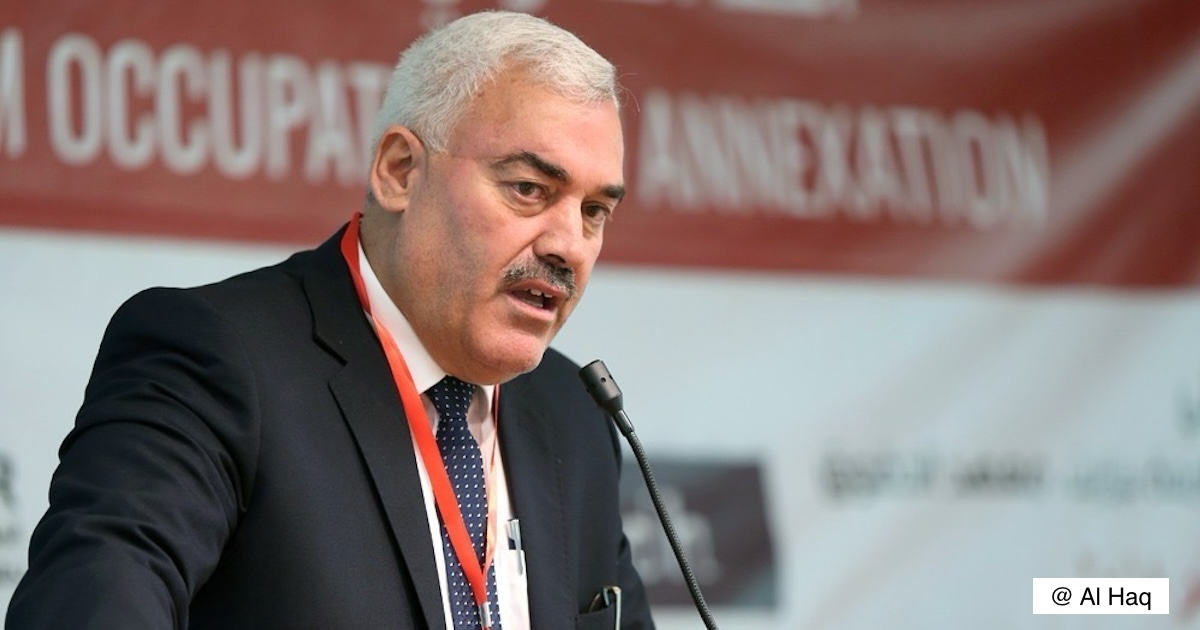
The decision by French authorities to deny visa access to prominent Palestinian human rights defender and General Director of Al-Haq, Shawan Jabarin, who was due to travel to the country this week as part for an advocacy trip, is an alarming setback for human rights.
Al-Haq, the oldest Palestinian human rights organisation and a pioneer of the human rights movement in the Middle East, is one of three prominent Palestinian human rights organizations – alongside the Gaza-based Al-Mezan and the Palestinian Centre for Human Rights (PCHR) – facing US government sanctions for their work with the International Criminal Court (ICC). In 2021, Al-Haq was also unlawfully criminalised by Israel after decades of smear campaigns and attacks against the organisation and its staff.
“It is both shameful and deeply troubling that a human rights defender who has dedicated his life to pursuing justice for international crimes is denied entry into the Schengen area, while individuals wanted for war crimes and crimes against humanity are able to travel freely. This stark and absurd double standard should prompt urgent reflection among European states on their commitment to accountability and the consistent application of international justice,” said Agnès Callamard, Secretary General of Amnesty International.
“Al-Haq, Al-Mezan and the Palestinian Centre for Human Rights have made an immense contribution to the global human rights movement, courageously and rigorously documenting abuses, speaking out for victims, and defending the very universal values that France claims to uphold. In 2018, France awarded Al-Haq the prestigious French Republic Award in recognition of its human rights work, which was received by Mr. Jabarin himself. We urge the French authorities to reverse their decision immediately and commit to granting visa access to Mr Jabarin,”said Alexis Deswaef, President of International Federation for Human Rights (FIDH).
Alongside the three Palestinian organisations, the US sanctions list also includes eight ICC judges, three ICC prosecutors and the UN Special Rapporteur on the Situation of Human Rights in the Occupied Palestinian Territory.
“In 2025, Israeli Prime Minister Benjamin Netanyahu, wanted by the ICC for war crimes and crimes against humanity in Palestine, was welcomed in Hungary, and a Libyan ICC fugitive was able to enter and leave Italy, thereby entering and leaving the Schengen zone without arrest or objection from other Schengen area states. In the meantime, human rights defenders seeking to support justice are being punished and prevented from doing their legitimate human rights work,” said Alison Smith, CICC Secretariat Director.
Several countries, including France, have spoken out publicly against the sanctions, with French President Emmanuel Macron directly requesting President Trump to lift the sanctions against French ICC Judge Nicolas Guillou. They have also denounced Israel’s criminalisation of human rights organisations. France must maintain this stance and refuse to be perceived as caving to US sanctions or Israeli designations.
In October 2025, a month after the US designation against the Palestinian organisations, Shawan Jabarin’s Schengen visa application was rejected by “one or several EU member states” on the ground that he would be a “threat to public policy or internal security”. On 10 April 2026, Mr Jabarin was scheduled to travel to Europe for a series of public engagements about the sanctions and concrete steps the EU and its member states could take to support and protect the ICC and those cooperating with it. These engagements are being conducted together with the directors of PCHR and Al Mezan and several international NGOs. Given his prior Schengen visa rejection, Mr Jabarin applied for national visas from the countries he was supposed to visit: Belgium, France and the Netherlands.
At the eleventh hour, France denied his national visa, preventing him from participating in upcoming briefings with the French Parliament, civil society organisations and the French Ministry of Foreign Affairs. Further, France’s delay in providing a response to Belgian and Dutch authorities prevented Mr Jabarin from participating in several planned engagements at the European Parliament and at the Belgian Ministry of Foreign Affairs. The Netherlands and Belgium did subsequently issue a national visa that enables Mr Jabarin to participate in the remaining planned engagements in the Netherlands. However, the refusal by France has already prevented Mr Jabarin from participating in some engagements and restricted his conduct of essential human rights and advocacy work, including on the impact of sanctions on the international justice ecosystem.
This denial of a visa sends an extremely alarming message from France, especially in the context of the global shrinking space for human rights work worldwide and the escalating attacks on international law itself. The refusal to issue a visa is yet another example of restrictions against human rights defenders. If linked to US sanctions or Israeli designations, it would be an extremely worrying escalation in the extra-territorial application of sanctions against those working on justice and accountability.
Signatories:
- Amnesty International
- Coalition for the International Criminal Court
- International Federation for Human Rights (FIDH)
- No Peace Without Justice
- Avocats Sans Frontières
- ECCHR
- Euromed Rights