

The intensification of short-range drone attacks in Ukraine: implications for emergency and humanitarian response
25 September - 12:00 - 13:00
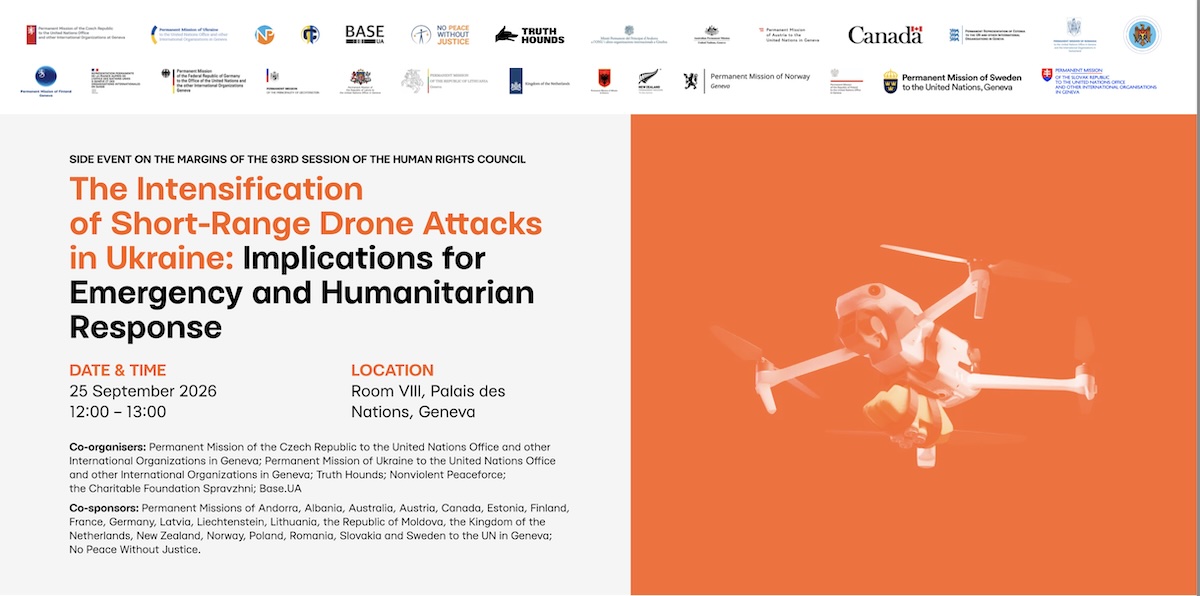
Side Event on the margins of the 63rd Session of the UN Human Rights Council
– Date: 25 September 2026
– Time: 12:00 – 13:00
– Location: Room VIII, Palais des Nations, Geneva
– Co-organisers: Permanent Mission of the Czech Republic to the United Nations Office and other International Organizations in Geneva; Permanent Mission of Ukraine to the United Nations Office and other International Organizations in Geneva; Truth Hounds; Nonviolent Peaceforce; the Charitable Foundation Spravzhni; BASE.UA.
– Co-sponsors: Permanent Missions of Albania, Andorra, Australia, Austria, Canada, Estonia, Finland, France, Germany, Latvia, Liechtenstein, Lithuania, the Republic of Moldova, the Kingdom of the Netherlands, New Zealand, Norway, Poland, Romania, Slovakia and Sweden to the UN in Geneva; No Peace Without Justice.
– Concept note
Background and Context
Short-range drones have fundamentally changed the character of contemporary warfare and, with it, the way emergency services and humanitarian missions can operate. In Ukraine, Russian forces have increasingly used short-range drones in attacks affecting civilians and civilian objects, including first responders and humanitarian personnel carrying out life-saving activities in frontline areas. The scale and persistence of these attacks illustrate how the proliferation of short-range drones can create new risks for civilian populations and significantly constrain humanitarian and emergency response operations in areas affected by hostilities.
Recent monitoring indicates a broader deterioration in the operating environment for humanitarian actors in Ukraine. Between January and June 2026, violence against humanitarian personnel increased by 20 per cent compared with the same period in 2025, while instances in which hostilities prevented humanitarian personnel from reaching affected areas, or civilians from reaching humanitarian assistance, increased by 225 per cent. These trends demonstrate that attacks and threats against humanitarian and emergency responders have consequences extending beyond individual incidents: they can prevent assistance from reaching civilians who depend on it.
This event builds on research and field documentation by Truth Hounds concerning short-range drone attacks and the apparent targeting of emergency responders in frontline regions of Ukraine. It will present new findings on the risks faced by first responders and humanitarian personnel and examine the practical measures increasingly used to mitigate those risks, including electronic warfare and jamming devices, drone detectors, armoured vehicles and other protective equipment.
The discussion will also address a protection gap which is becoming starker. Humanitarian and emergency personnel may operate in areas where conventional protective measures are insufficient, while access to specialised protective equipment remains limited. This raises practical and legal questions concerning the measures civilians can employ to protect themselves and others while continuing to perform humanitarian and life-saving functions, and how such measures should be understood under international humanitarian law.
Short-range drones also raise a broader question about the relationship between technological precision and civilian protection. Although these systems can enable highly targeted attacks at short range, their technical precision does not in itself guarantee compliance with international humanitarian law or reduce civilian harm. In Ukraine, documented patterns indicate that short-range drones can be used to repeatedly expose civilians, humanitarian personnel and first responders to direct and persistent threats, including while they are responding to previous attacks.
Similar challenges are emerging in other contemporary armed conflicts, where short-range drones are increasingly used for surveillance, reconnaissance, targeting and attacks in and around populated areas. The Ukrainian experience therefore provides an important case study for understanding how the proliferation and use of short-range drones is changing the protection environment for civilians and humanitarian actors more broadly.
Objectives
- Present new field evidence on attacks against first responders and humanitarian personnel in Ukraine and identify patterns in the use of short-range drones.
- Examine how the proliferation of short-range drones is changing the operating environment for humanitarian and emergency actors, including their ability to reach civilians in need.
- Identify gaps in access to protective equipment and practical self-protection measures available to humanitarian and rescue teams working in high-risk areas.
- Discuss the legal and operational implications of measures such as jamming devices, drone detection, and armoured vehicles for civilian and humanitarian actors under international humanitarian law.
- Place the Ukrainian experience in a broader cross-conflict context and identify common protection challenges and means of overcoming them.
- Engage Member States, UN Special Procedures and monitoring mechanisms on concrete measures to strengthen protection, documentation and accountability.